Tag: Topaz Adjust

Freebird

Chevy
Freebird

This image is another pseudo HDR I created a couple of years ago using  Topaz Adjust. The advantage of using these plug-ins is that they can often salvage an otherwise flat image and allow me to create something rich and dynamic. The ability to extract information and enhance the colors and details within the original file is the main reason I started using them. I don’t think they are an answer for every situation, if the image is poorly composed they won’t help it, but if the exposure range is too extreme they can be invaluable and allow me to rescue my original idea for the photo.

This image works because of the composition which adheres to the rule of thirds. By giving the car the bottom two thirds of the frame and placing the hood ornament at the intersection of the of the upper right third of the frame the viewer’s eye is directed there. The colors of the sky reflect in the chrome and tie the blue of the sky into the dark browns and oranges of the rust on the car. The yellowish orange of the clouds further emphasizes the complimentary color scheme of the photo too.

 

Redneck Racing Team’s Dragster at Beech Bend Raceway

Redneck Racing Team’s Twin Engine Dragster

This image is from the Hot Rod Reunion which is held annually at Beech Bend Raceway in Bowling Green Kentucky. Every year this event attracts nostalgic hot rodders from around the US for a weekend of vintage style drag racing and a hot rod car show. The theme of the event is centered around the early days of the sport and brings out many old race cars from the 50s and 60s when drag racing was still done with grass roots cars and drivers. During that era most dragsters and drag cars were built by hot rodders in their own backyard garages. Those early racers would design and build the chassis then search the wrecking yards for engines to power them. The engines would be hopped up using limited tooling and speed parts that were sourced from small speed shops across the country. There were no major sponsors or multi-million dollar budgets like the current drag racers have; for the most part it was just the money the team could scrape up from their day jobs and local sponsors. There were very few large purses and about all those early racers took home after a day of competition was a cheap trophy and bragging rights for being the fastest car there.

This particular dragster is reminiscent of that era though it is unique in that it has twin engines. During that era the benchmark for high performance engines was to squeeze one horsepower per cubic inch from an engine. An example would be the Chevrolet Corvette V-8 which had a displacement of 283 cubic inches and in race tune that engine was capable of making 270 horsepower. One way to build a car with more power was to put two engines in it and effectively double the horsepower. The car in this photo is using twin engines in an effort to get the most power they can for a small price. The down side of that much power was that the tires of that time were not capable of getting the power to the track and instead spun for long distances from the start line. This car shows that effect as it powers down the racetrack spinning it’s tires and billowing smoke after getting the green light.

I captured this image in the middle of the day which as all photographers know is some of the harshest light to shoot in. By using Topaz Adjust I was able to enhance the detail and color in the scene and produce an acceptable image. I made this image a couple of years ago when I was first getting into using plug-ins such as Topaz Adjust and it reflects the state of HDR photography at that time. I, like many other photographers, was pretty heavy handed with the color saturation and sharpening that the plug-ins created but at the same time I was enjoying the results as they were so much richer than anything I had done before. Since those early days I have started to move into a more realistic style of HDR processing that, while still creating rich color and detail, is more in line with how the scene appears in real life.

This composition relies on the standard rule of thirds as well as strong diagonal lines that sweep from left to right. The position of the car heading out of the frame reinforces the billowing cloud of tire smoke and the sense of movement it conveys while the perspective of the spectator bleachers creates depth as the viewer’s eyes move into the background.

Bumsted

Bumsted

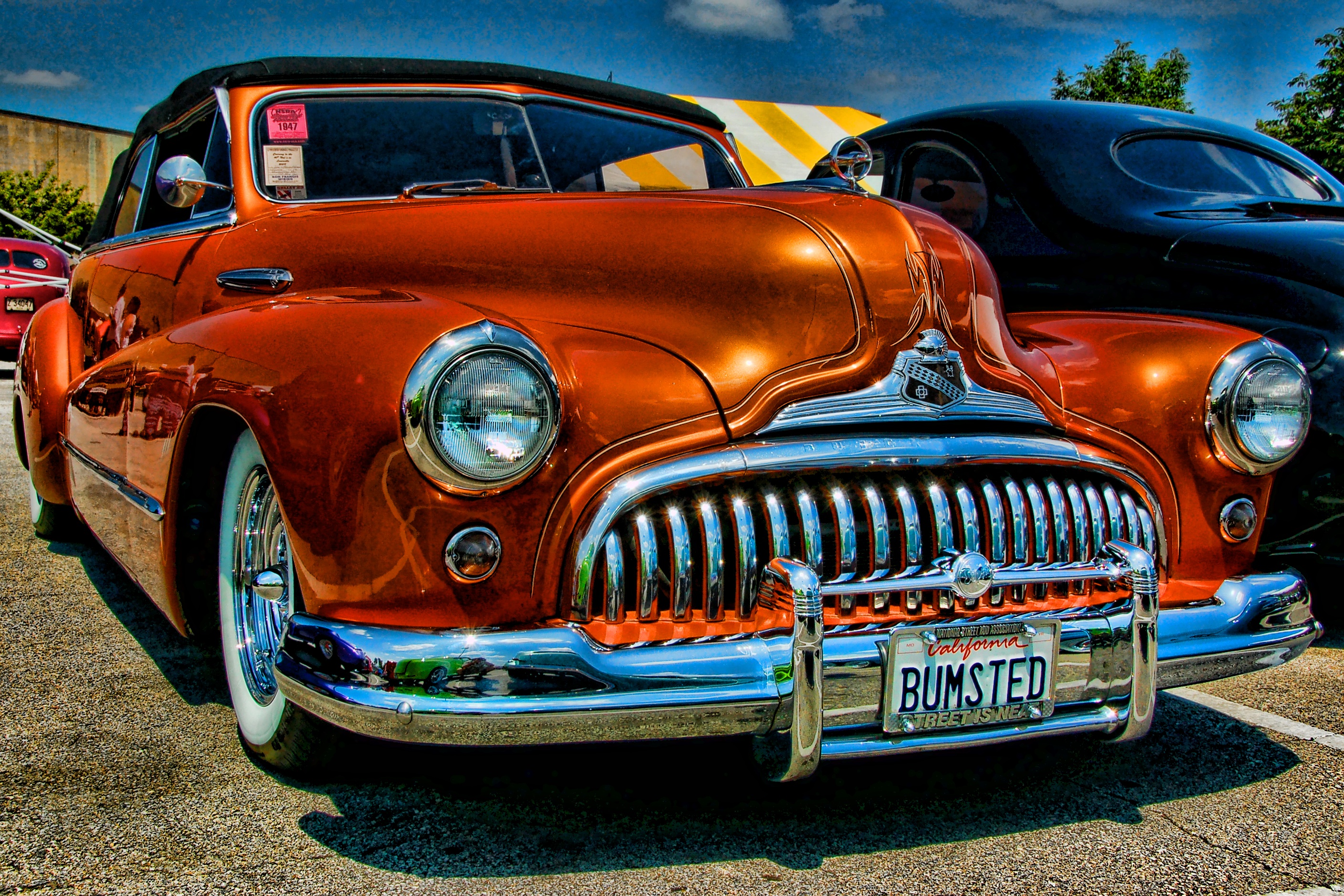
This image is another photo from the NSRA Streetrod Nationals in Louisville, KY. I processed this image using the Topaz Adjust Spicify preset. Not a lot to add about processing except to point out that the fact that when using presets such as Spicify there is always the potential for excessive noise in the image. I processed this image at a time when I was just starting to use Topaz Adjust and looking back at the image I would probably dial the strength of the preset down some in an effort to reduce the noise in the sky and the reflections in the paint on the car.

I like the composition for a couple of reasons in particular the low camera angle that really emphasizes the voluptuous form of the car. The placement of the subject creates a tension as the car seems to be moving forward in the frame. I did this to showcase that massive grill and front bumper and to emphasize the front vanity license plate. The complimentary colors of the orange car with the blue sky add interest from the standpoint of color balance.

Cadillac Abstract

Cadillac Abstract

This image is a macro of the glass in a 1931 Cadillac Sedan I saw last year at the NSRA Streetrod Nationals. This particular car was impecable in every way but the owner had chosen not to replace any of the glass in the car. These early cars had a type of safety glass that was made by taking two layers of glass and fusing them together with a clear plastic membrane that was sandwiched between them. Over time the membrane will sometimes start to delaminate and the result is an amber looking pattern usually at the edges of the glass. This car’s glass had done that at the bottom of every piece of glass in the car and the restorer had kept it in the car. I couldn’t resist the abstract patterns and colors and took several photos of it though I’m not sure I took any of the car itself.

I processed this image in Topaz Adjust which allowed me to intensify and enhance the colors in the delamination. Once again I took a subject that I had seen and photographed innumerable times and found a new way to interpret it. Keep your eyes open when you are looking at something you have photographed many times before and you just may stumble onto a gem such as this image.

Homage to the Renaissance

Reflections in a Chrome Eye

Sometimes the simplest things can yield surprising results. As I searched the Streetrod Nationals for reflections in cars I came across this car parked in the grass which was a great mirror for the two red vehicles parked nearby. I thought about the way the painters of the Renaissance used convex mirrors in their paintings to capture distorted perspective and decided to go with that concept.

I would call this a radial composition due to the many concentric circles which focus the viewer’s eye on the image within the image though it also conforms to the rule of thirds. The colors in the image are primarily red and green which are complimentary colors and lend harmony to the scene and further strengthen the composition. I also enjoy the way the colors in the wheel are inverted from the center section where the green grass and blue sky are revealed; to the outer portions of the wheel where the green is now on the upper side and the blue has moved to the bottom. The reds of the reflected vehicles benefit too from the red jewel on the tire’s valve cap which adds a small foreground element to the image.

I first processed this image with Aperture 3 where I cropped it slightly to remove extraneous details that were interfering with my initial concept for the photo. I then I opened it in Topaz Adjust for the final enhancements which intensified the colors in the chrome and the scene within the center cap, along with the sky.