Click on the image to open it in a new window.
Click on the image to open it in a new window.

Click on the images to open them in another window
These images are black and white conversions of HDR images that I created from a three shot bracket set using +2, 0 and -2 EV frames that I first merged in NIK HDR EFex Pro 2 to create a HDR image. After merging and tone mapping them I returned them to Aperture 3 where I applied the black and white adjustment with an orange filter. I also sharpened them and added a little mid-contrast to show the texture in the rust and intensify the shadows.


Click on any image to open it in a new window.
As a rule Louisville doesn’t get a lot of snow and this winter has been one where we have had maybe 5 or 6 snows. The weather here has changed a great deal from when I was a boy growing up here in the 1950s. Back then we would get really cold winters with snow from November thru April. We could go sledding for days on end and once the snows fell they stayed around for a long time. That has all changed in the past 10 or 15 years and now we seldom have a snow that stays around more than a few days.
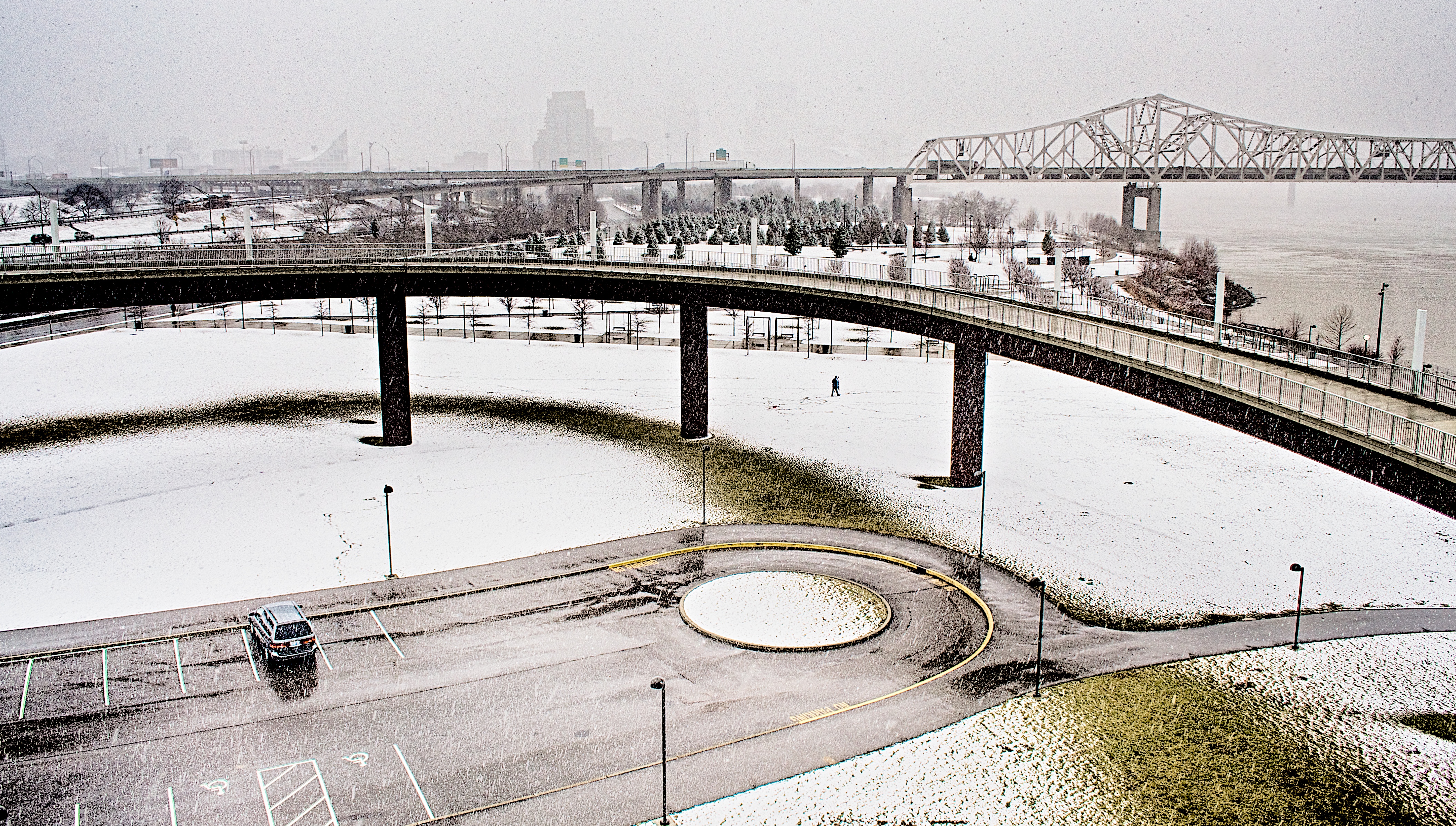
Last Wednesday we had snow showers in the morning and by afternoon the temperature was back in the mid 40s. I was in town visiting at my friend Chuck Rubin’s used camera store when I looked outside to see a heavy wet snow falling. I jumped at a chance to photograph Waterfront Park in the snow and immediately headed down to the park. I decided to shoot from the Big Four Bridge, (I’m sure everyone who reads this blog is surprised to hear that LOL), since the snow was really coming down and was covering the ground quickly. Later that afternoon the temperature was back in the upper 40s and the snow was gone as quickly as it arrived
I shot everything in bracket sets of +2, 0 and -2 EV so that I could process them as HDR images. The light was fairly bright so I kept my ISO set at 200 which resulted in fairly fast shutter speeds. The snow was so dense that it rendered itself in gray tones and bright highlights much as clouds do when the sun is in and out. I used NIK HDR Efex Pro 2 to merge the frames and created a couple of my own presets starting with the Deep #2 preset as my basis. I was able then to move through the several merged sets in a little less time than trying to adjust each merged set individually. Even with that I still had to make adjustments to my preset depending on the balance of light and dark in the individual HDR images.
After completing my initial processing in NIK HDR Efex Pro 2; I opened each one in Aperture 3 where I completed the adjustments for exposure, contrast, detail, vibrance, and sharpening. I also did a small amount of spot removal where individual snowflakes rendered themselves as sensor spots sometimes do. I did not attempt to remove every snowflake’s shadow from the sky because part of what I wanted to convey was how large and dense they were.
Below you will find more from that day’s photo shoot. I hope you enjoy them and will comment where you think appropriate. I converted some of the images to black and white after merging them in NIK HDR Efex Pro 2 to create a different version that was more about contrast and form than color.


Click on an image to open it in another window.
I wanted to try something a little different with these bridge images. I decided to take them into Nik Siver Efex Pro and see what might come from that. I first used my -2, 0, and +2 EV bracket set to create a HDR image in NIK HDR Efex Pro 2 which I then adjusted for exposure and tone mapped it. I returned it to Aperture 3 where I made a few adjustments to saturation, vibrance and detail slider before doing my final sharpening. After doing that I took that image into NIK Silver Efex Pro where I used the antique preset to create the image above.

For the image above I followed essentially the same process, bracket set to HDR then back to Aperture for some adjustments and finally into NIK Silver Efex Pro where I applied the neutral preset and chose the Agfa 400 film look along with a little red filter to finish it

Click an image to open it enlarged in another window.
These images are some of the last images I shot of the Big Four Bridge before it opened to the public. It was a bittersweet moment as I stood there that morning looking at the finished project. I thought back to my first day up there and how much it had changed in the six months that had ensued.
I remembered how frightened I was as I first walked near the edge with only the safety cables to protect me. I thought back to my first view of the city from up there and how beautiful the Waterfront Park looked. I recalled the days when Tim took me up in the manlift to view the bridge from above, to see it just as he and the ironworkers saw it. I thought about the amazing transformation that took place after the handrails were installed and the railroad tracks were cut and stained into the deck.
Most of all I felt a loss for the day to day interaction with the men working there and knowing that I wouldn’t be likely to see many of them again on the bridge. Recalling my first interaction with the construction crew, how we became friends; how they would ask me where I had been if I wasn’t there one day.
The thing I will miss the most is to have been a part of the team that gave Louisville a wonderful gift, a fantastic experience that I may never have again. I will cherish this bridge and the company of the men who rescued it for the rest of my life. Whenever I go there or drive past there those guys will be in my thoughts and a smile will form.

Both of these images are multiple exposures, three frames each, merged in HDR Efex Pro 2 and finished in Aperture 3. I shot the bracket set handheld at +2, 0 and -2 EV which was possible mainly because it was such a bright day and the shutter speed was high. I have begun to employ the bracketing feature on my Nikon D90 more and more when shooting HDR. I find it allows me to focus my attention on the framing of the image more easily. It also frees me from my tripod when I’m on the move or the situation doesn’t favor using a tripod. The only downside I have found is that these bursts of images sometimes overwhelm the camer’s processor and slow down my shooting.