Category: Car

Big Eye

Stutz Bearcat at Keeneland

This image is from my trip to Keeneland’s 2012 Concours de’Elegance last Saturday. I am fascinated by the size and detail of the early automobiles I see at these events such as this headlight on a Stutz Bearcat. According to the owner this car is one of only three known to still exist.

Due to the size of the crowd it was nearly impossible to photograph the cars without someone stepping into the shot so I decided to shoot details of the cars instead. I was able to keep the crowd out of these shots because I moved in close to the cars and got down low in front of them. Sometimes I was even laying on the ground to get an angle that allowed for an interesting composition; the people around me must have thought I was having a stroke when they saw an old man prostrate on the ground. At any rate it helped to keep them out of my camera’s line of sight.

I first processed this image in NIK HDR Efex Pro 2 as an HDR from a single image and then saved it back into Aperture 3. I then took it into NIK Silver Efex Pro where I converted it to black and white. I made a few adjustment while in there and then back to Aperture 3 for my final processing. There were some branches intruding on the left side that I cloned out using the retouch feature in Aperture 3. I then made a few contrast adjustments and some minor sharpening before saving the image.

Keeneland Concours de’Elegance

HDR Efex Pro 2 Packard image
Blue Packard

I took a trip down to Lexington, Kentucky this past weekend to the Keeneland Concours de’Elegance auto show. I have always been interested in automotive design and an event such as this one allows me to see firsthand the craftsmanship and beauty of our automotive heritage.

This Packard caught my eye with it’s massive headlights and brilliant grillwork. I decided to shoot this image as a bracketed series of images in order to overcome the wide range of light that the dark car and the brilliant chrome created. I knew that I was going to finish this image as an HDR image when I shot it. I monitored my histogram which showed me that I had the full range of tones in four exposures which would result in a good HDR image once merged and tone mapped.

Back home in the studio I merged the four exposures in NIK HDR Efex Pro 2 and applied the Structurized 2 preset as my base image. I adjusted the structure, black point and white point sliders very slightly before saving the image back into Aperture 3. I had to place a control point on the building in the lower right side of the frame and increase the exposure on the stonework to keep it from being a dark distraction in the composition. Once the image was back in Aperture 3 I cleaned up some sensor spots that had been emphasized by the tone mapping and hdr conversion before adjusting the vibrancy and sharpening the image for final output.

The composition is a pretty straight forward rule of thirds and uses the repetition of form to unify it. That along with the complimentary color scheme of blue and gold makes this image work for me.

Redneck Racing Team’s Dragster at Beech Bend Raceway

Redneck Racing Team’s Twin Engine Dragster

This image is from the Hot Rod Reunion which is held annually at Beech Bend Raceway in Bowling Green Kentucky. Every year this event attracts nostalgic hot rodders from around the US for a weekend of vintage style drag racing and a hot rod car show. The theme of the event is centered around the early days of the sport and brings out many old race cars from the 50s and 60s when drag racing was still done with grass roots cars and drivers. During that era most dragsters and drag cars were built by hot rodders in their own backyard garages. Those early racers would design and build the chassis then search the wrecking yards for engines to power them. The engines would be hopped up using limited tooling and speed parts that were sourced from small speed shops across the country. There were no major sponsors or multi-million dollar budgets like the current drag racers have; for the most part it was just the money the team could scrape up from their day jobs and local sponsors. There were very few large purses and about all those early racers took home after a day of competition was a cheap trophy and bragging rights for being the fastest car there.

This particular dragster is reminiscent of that era though it is unique in that it has twin engines. During that era the benchmark for high performance engines was to squeeze one horsepower per cubic inch from an engine. An example would be the Chevrolet Corvette V-8 which had a displacement of 283 cubic inches and in race tune that engine was capable of making 270 horsepower. One way to build a car with more power was to put two engines in it and effectively double the horsepower. The car in this photo is using twin engines in an effort to get the most power they can for a small price. The down side of that much power was that the tires of that time were not capable of getting the power to the track and instead spun for long distances from the start line. This car shows that effect as it powers down the racetrack spinning it’s tires and billowing smoke after getting the green light.

I captured this image in the middle of the day which as all photographers know is some of the harshest light to shoot in. By using Topaz Adjust I was able to enhance the detail and color in the scene and produce an acceptable image. I made this image a couple of years ago when I was first getting into using plug-ins such as Topaz Adjust and it reflects the state of HDR photography at that time. I, like many other photographers, was pretty heavy handed with the color saturation and sharpening that the plug-ins created but at the same time I was enjoying the results as they were so much richer than anything I had done before. Since those early days I have started to move into a more realistic style of HDR processing that, while still creating rich color and detail, is more in line with how the scene appears in real life.

This composition relies on the standard rule of thirds as well as strong diagonal lines that sweep from left to right. The position of the car heading out of the frame reinforces the billowing cloud of tire smoke and the sense of movement it conveys while the perspective of the spectator bleachers creates depth as the viewer’s eyes move into the background.

STOP!

STOP!

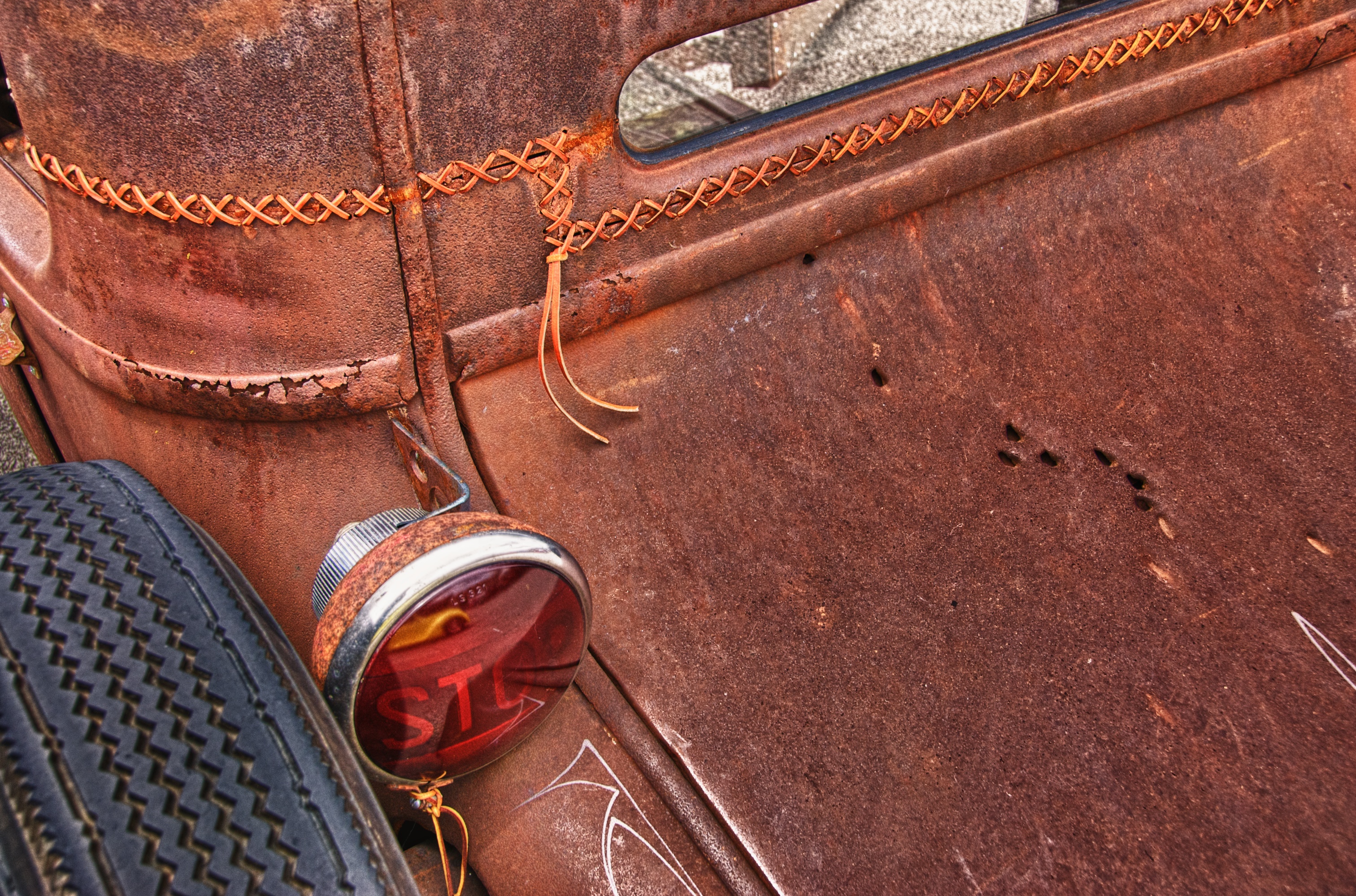
I found this car at a local car show. I have never seen a top that was chopped and then laced back together but the rat rod crowd does some interesting fabrication. I liked the way the rusted patina of the car contrasted with the slick finish of the yellow car reflected in the stop light. I thought the inclusion of the bullet holes in the rear deck lid helped add interest to the right hand side of the image.

I framed it in as a classic rule of thirds placing the red light at the intersection of the lower third section and the left third section. I processed this image using the NIK HDR Efex Pro plug-in and finished it in Aperture 3.

More Vintage Tin HDR


This image is another HDR shot from last year. It is a single image that was tone-mapped using NIK HDR Efex Pro which helped me accent the textures of the rust and the paint while keeping the detail in the headlight and light bulb.

The composition relies on complimentary colors, red and green, to give it harmony while the repetition of form in the round headlight, turn indicator, and the horn contrast nicely with the vertical elements on the right side of the frame.